
There is no single success rate that can tell you what couples therapy will do for your relationship. Research gives good reason to take the work seriously, but a percentage cannot predict whether two particular partners will rebuild trust, communicate differently, or decide on a healthier path forward.
The most honest answer is that couples therapy helps many distressed couples improve, and the results depend on what you mean by success, the kind of help you receive, and what both partners are able to bring to the work. A recent review of decades of outcome research found clinically significant improvement in relationship satisfaction and stability for roughly 60% to 70% of distressed couples. The review also explains why that figure is an average, not a promise.
Success Means More Than Staying Together
Some partners begin therapy hoping to save a marriage. Others want to stop the cycle of conflict, understand why trust has become so fragile, or decide whether there is enough willingness to keep trying. Those are different goals, and they call for different measures of progress.
A relationship can be improving before it feels easy. You may notice that a hard conversation stays on one subject instead of turning into a list of old injuries. You may be able to take a break without one partner hearing it as abandonment. An apology may become more specific, or a concern may be raised before resentment has had months to build.
For some couples, clarity is a meaningful outcome. If one partner is not sure they want to continue the relationship, trying to force standard couples therapy can create more pressure than help. Discernment counseling gives partners a more honest place to decide what they want to do next.
What Research Can and Cannot Tell You
Research can describe what happened across groups of couples. It can show changes in relationship satisfaction, distress, communication, or stability after treatment. It cannot tell you in advance exactly how your relationship will respond.
That matters because studies differ. They may examine different therapy approaches, different concerns, different lengths of treatment, and different definitions of improvement. A strong result in a research study does not mean every couple will have the same experience, and a difficult start does not prove your relationship cannot change.
The same review found that multiple recent meta-analyses reported positive effects for couple therapy, while also calling for stronger and more diverse research. That is a reason for realistic hope, not a guarantee.
How to Tell Whether Couples Therapy Is Helping
Before therapy begins, it helps to say what you want to be different. “We want to stop fighting” is understandable, but it can be hard to recognize progress from a goal that broad. A clearer goal gives you something you can notice together.
- Conflict: Can you bring up one concern without criticism, defensiveness, shutdown, or contempt taking over?
- Repair: Can either partner recognize a bad turn, pause with care, and return to the issue?
- Trust: Are promises followed by behavior that is open, consistent, and easier to believe over time?
- Connection: Do you have more moments of warmth, friendship, appreciation, or honest curiosity outside the crisis conversation?
- Teamwork: Can you make a decision about money, family, intimacy, parenting, or time together without treating one another as the problem?
These are not a scorecard for proving one partner is trying harder. They are practical signs that the pattern between you is changing. When a couple can name the pattern and respond to it differently, the relationship has more room to recover.
What Affects Whether Couples Therapy Helps
It is common for partners to arrive with different levels of hope. One may be eager to start, while the other is tired, skeptical, or worried that therapy will become another argument. You do not need to agree on every detail before the first appointment.
You do need enough willingness to be honest about what is happening and to try a process that asks both of you to look at your part in the cycle. Couples therapy is not a courtroom. It is a place to understand what happens between you when one person feels dismissed, criticized, overwhelmed, or alone.
When there is intimidation, threats, coercive control, physical violence, or fear of what will happen after you speak up, the priority is safety, not improving communication. Michigan residents can find immediate support options on the Crisis Support page.
A Clear Process Makes Progress Easier to Assess
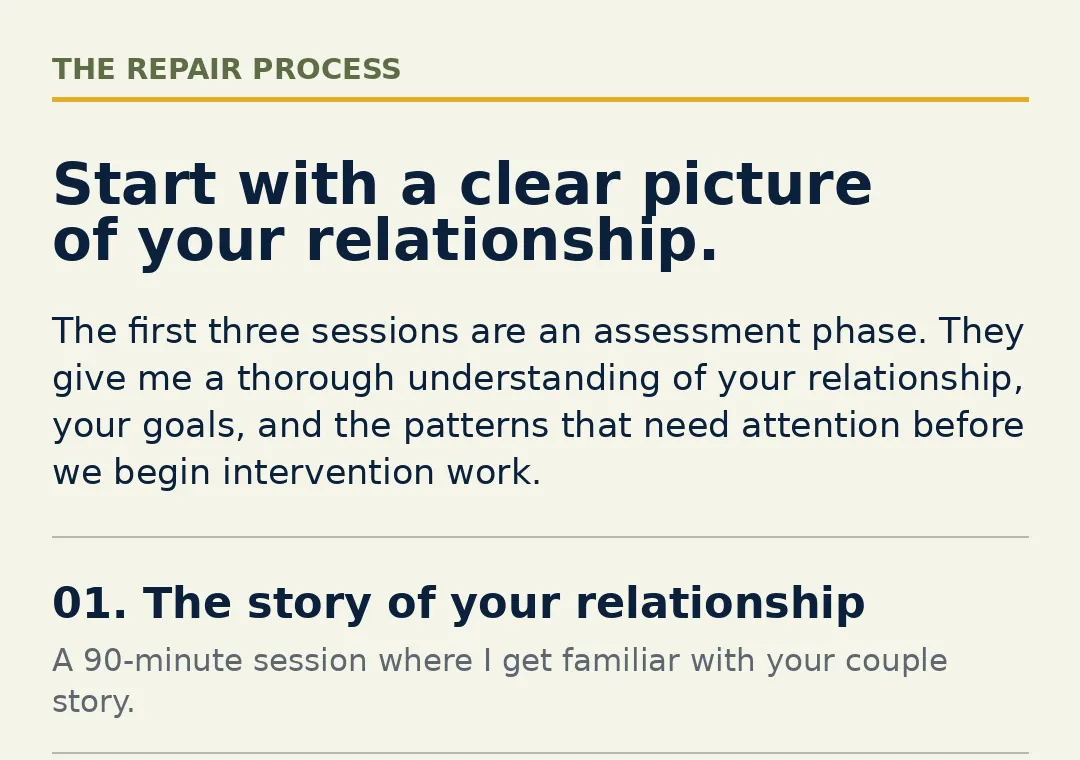
Therapy works best when partners can see what they are working on and why. An assessment followed by a clear treatment plan gives both partners a shared picture of the pattern and the work ahead.
That structure does not promise a particular result. It gives partners a plan for the skills or repair work that matter most, and a way to notice what changes between sessions. The first-session process explains one approach in more detail.
Questions to Ask Before You Begin
A fit call or first session should leave you with a clearer sense of whether the process makes sense for your relationship. You can ask direct questions without needing to know the right answer in advance.
- How will we decide what to work on first?
- How will you help us when one partner feels flooded or shuts down?
- What should we practice between sessions?
- How will we know whether the work is helping?
- What happens if one of us becomes unsure about continuing the relationship?
- What does a treatment plan look like for a couple with concerns like ours?
A helpful answer will not reduce your relationship to one technique or promise that every problem can be solved. It should give you a practical sense of how the work will be organized and what each partner can expect.
The Best Question Is Whether the Pattern Can Change
It makes sense to want a number before you invest time, money, and vulnerability in therapy. But the question that matters most is more personal: can both of you become more honest, more responsive, and less trapped by the pattern you are living in now?
If you want a structured way to answer that question, a couples therapy fit call gives you a chance to describe what is happening and decide whether couples therapy is the right next step. You do not need to know the outcome before you begin. You only need enough willingness to look clearly at what is happening and try a different way forward together.
Practice Between Sessions Makes the Work Real
A session can help partners slow down enough to understand a familiar pattern. The week between sessions is where that understanding meets ordinary life. You may try a different way to raise one concern, agree on a return time after a pause, or pay attention to the small moments that usually become a fight.
The goal is not to perform therapy perfectly at home. It is to notice what happens when you try a new response. If the conversation goes badly, that is useful information for the next session. You can look at where the pattern took over and make the next attempt more specific. Progress often comes from repeated practice, not one flawless conversation.
The Right Starting Point Depends on the Problem
Couples therapy is designed for partners who want to work on the relationship together. If the immediate concern is an affair or other broken trust, infidelity counseling can focus the work on honesty, accountability, and whether repair is possible. If you are preparing for marriage, premarital counseling offers a structured way to talk through expectations before daily pressure makes those conversations harder.
Choosing the right starting point does not make the work easy. It does make it more honest. A good first step fits what is true about the relationship now, rather than asking partners to act more certain, more hopeful, or more ready than they are.
It also helps to remember that a relationship is not a research category. Your history, the issue bringing you in, and the choices you each make during the work matter. The purpose of a rate is to give context, not to hand you a verdict before either of you has had the chance to be heard.